
This story is related to the landscape initiative “Aceh Timur”, and originally published on SourceUp.
News Article
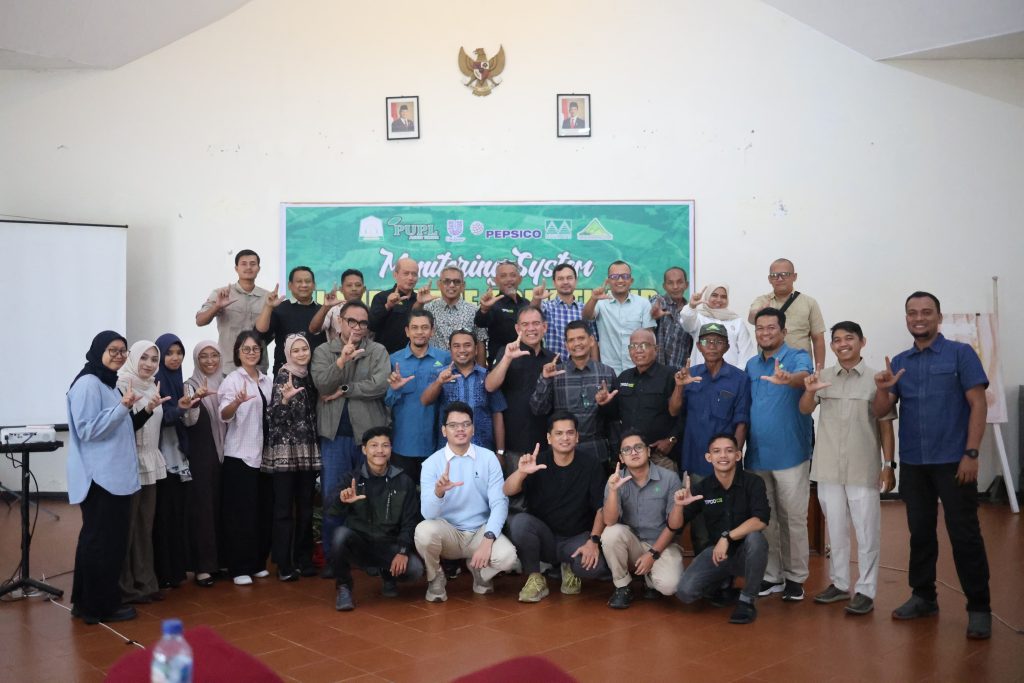
Berastagi, April 9, 2026 – A Monitoring System Training for the Regional Deforestation Monitoring Team (TPDD) of Aceh Timur was held over two days, April 7–8, 2026, at Sibayak International Hotel, Berastagi, North Sumatra, in collaboration with the Ministry of Environment, the World Resource Institute (WRI) Indonesia, the Sustainable Trade Initiative (IDH), the Center of Excellence of Sustainable Production (PUPL) of Aceh Timur, and the Leuser Conservation Forum (FKL). The training was conducted to strengthen the team’s capacity in monitoring deforestation effectively.
During the training, participants from various institutions gained a foundational understanding of deforestation, field monitoring techniques, and the use of relevant tools such as GIS and satellite imagery, as well as data reporting mechanisms.
On the first day, the training focused on concepts, regulations, and the urgency of addressing regional deforestation through interactive discussions with experts from national and local government agencies and organizations, including the WRI Indonesia and the FKL. On the second day, the training shifted to technical capacity building, covering data collection techniques, monitoring system reporting, GIS, and satellite imagery analysis.
Benita Nathania, Senior Lead for Forest and Landscape Monitoring at WRI Indonesia, noted that within the Aceh Timur region, 86% of primary forest lies within the Leuser ecosystem. Of the total land area, 56% of the 543,000 hectares consists of primary forest. Over the past two decades, Aceh Timur has lost approximately 26,000 hectares of forest, with an average annual loss of around 1,100 hectares per year. As of 2024, remaining forest cover stands at approximately 242,000 hectares.
Given these alarming figures, the TPDD’s role in deforestation monitoring is critical. The data collected by the team serves as the foundation for policy making, program planning, and decision making related to forest and environmental management in the region. Ensuring that the team is equipped with the necessary capacity is therefore essential.
The challenges faced by the TPDD team were also discussed during the training, including a very wide monitoring area coverage, inaccessible locations, limited integrated data, and a lack of community participation in reporting deforestation. Therefore, the success of deforestation monitoring does not only depend on the TPDD team, but also on other stakeholders such as local government, civil society organizations, law enforcement officers, and communities living around the forest area.
The organization team stated, “We hope that with consistent implementation, this training will help reduce deforestation rates in Aceh Timur, raise community awareness on forest protection, and support better policy making through accurate monitoring data, ultimately leading to more sustainable forest management.”