
This story is related to the landscape initiative “The Mosaik Initiative”, and originally published on SourceUp.
From Farmer to Guardian of Justice: Rija’el’s Journey as a Village Paralegal
The presence of village paralegals proves that access to justice can emerge from the grassroots, even amidst limited infrastructure and legal understanding.
In Pematang Limau Village, Seruyan Hilir Sub-district, the figure of Rija’el Pahlepi is now known as the person villagers turn to for legal matters—a role far different from his life over a decade ago as a palm oil plantation worker. For fifteen years (2006–2021), he wrestled with the routines of plantation work before finally deciding to return to the village, cultivate rice, and become one of the small vendors for an Industrial Plantation Forest (HTI) company. That decision, unexpectedly, opened a new path for him: becoming a paralegal.
In mid-2024, Rija’el was introduced to the concept of paralegals by Gawi Bapakat. For him, the term sounded unfamiliar. However, the more he understood it, the greater his curiosity grew.
“Through paralegals, I learned that law does not only belong to those who work as lawyers, but it can also be a tool for communities to protect themselves,” said Rija’el.
Although he was only a high school graduate, his determination to understand the law never faltered. He then enrolled at the Faculty of Law, Universitas Terbuka Palangka Raya, convinced that education was the path to strengthening his role. For him, legal knowledge is not merely a title but a provision to make more meaningful contributions to the village and community.
Guarding Disputes and Forming Village Regulations
Now, Rija’el is no longer just a farmer. He has become the spearhead in resolving various legal issues in Pematang Limau. From facilitating the birth of a Village Regulation on Free, Prior, and Informed Consent (FPIC/PADIATAPA) to mediating land conflicts between villagers and companies, he consistently carries out all these responsibilities.
One struggle he continues to accompany is the recognition of customary institutions or Indigenous Peoples (MHA). For Rija’el, this is not merely a legal matter, but a collective effort of villagers to preserve their identity and ensure its official recognition.
“Many people in Pematang Limau still do not understand the law or realize that certain activities can violate it. That is why the role of paralegals is so important,” he explained.
Together with the village government and assisted by Gawi Bapakat, he is currently overseeing the draft of the Village Regulation on FPIC (Free, Prior, and Informed Consent/PADIATAPA). For Rija’el, such regulations are not just documents but a fortress for the community, ensuring they are no longer easily harmed by external parties.
From Team Nine to LBH Hatantiring
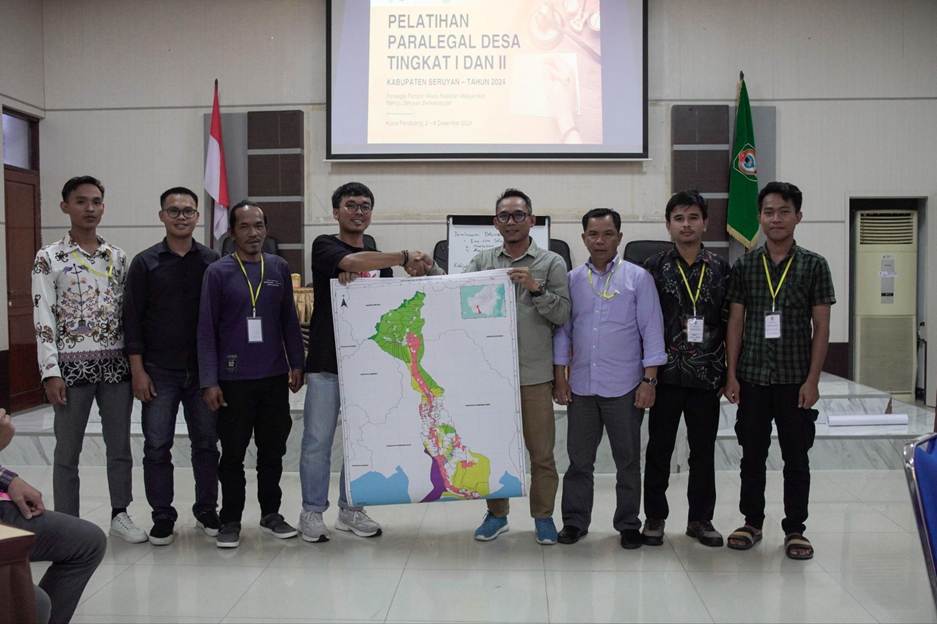
Rija’el’s role became more prominent when he was entrusted as Chair of Team Nine—a group of paralegals pioneering the establishment of LBH Hatantiring, the umbrella institution for all paralegals in Seruyan. Today, he serves as the Chair of LBH Hatantiring, which is currently preparing SOPs and bylaws to strengthen the institution.
Despite the limitations, Rija’el remains optimistic. He hopes paralegal work can be sustained. “We hope for tangible support from the government so that the existence of paralegals, which has already been formalized through decrees, truly gains reinforcement and attention, including for the sustainability of their work,” he said.
For Rija’el, paralegals are not only about resolving disputes but also about giving villagers the confidence to face the law. He believes every case that is accompanied is part of a collective learning process toward a more just and legally aware village.
In the rice fields, Rija’el works like any ordinary rice farmer. But in the village mediation room, he plants something much greater: the seeds of justice.