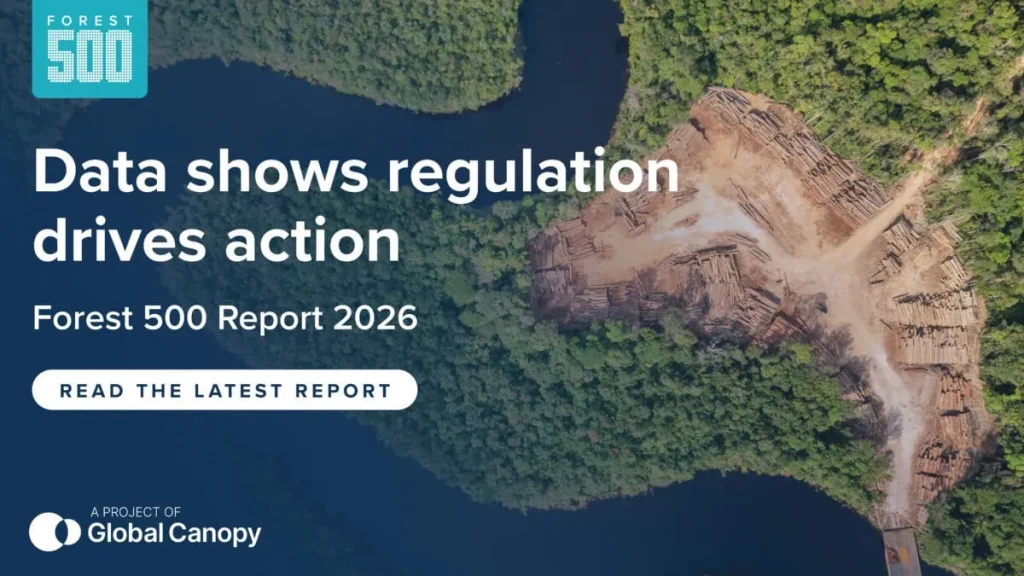
Forest 500 data shows regulation is driving corporate action on deforestation
Forest 500 data shows regulation is driving corporate action on deforestation
This article was originally published by Forest 500.
Global Canopy’s 12th annual Forest 500 report, Data shows regulation drives action, reveals that the incoming EU Deforestation Regulation (EUDR) has already shaped business expectations, galvanised investment and driven supply chain action by some of the world’s most influential companies – even before its implementation.
The regulation, due to be implemented from the end of 2026, will require companies to demonstrate that EU imports and exports of key commodities are deforestation free. Forest 500 data shows that many companies are already responding to the prospect of these requirements.
Key findings
In 2025, the number of companies with public evidence of a traceability mechanism – a key EUDR requirement – increased for eight of the nine Forest 500 commodities.
68 (14%) companies cite the EUDR in public documents related to action on forest loss.
45 companies, including Domino’s Pizza, Ferrero and Brazilian meat packer FriGol, directly cite the EUDR as a driver for action on traceability mechanisms taken in 2025.
“The data points to companies gearing up for the prospect of the EUDR even before its implementation. As Forest 500 data relies solely on public disclosures by companies, this is likely just the tip of a bigger iceberg of corporate decisions taken in private. This shows the positive influence that regulation can have and why sustained leadership by governments in key markets, like the EU and the UK, is so urgently needed.” – Chloe Rollscane, Research Associate at Global Canopy
Looking at corporate action on deforestation more broadly, progress remains uneven and significant gaps persist.
Forest 500 companies are grouped into three performance categories: leaders, late majority and laggards:
19 (4%) leaders have strong deforestation commitments for all the commodities they are assessed for and report significantly stronger implementation than most. Nestlé and Flora Food Group are in this group.
313 (63%) late majority companies have made only partial commitments and/or achieved weak progress on implementation.
132 (42%) of the 313 late majority companies reported progress on implementation in 2025 compared to what they reported in 2024. In this group are IKEA and Mondelēz International.
168 (33%) laggard companies have no deforestation or ecosystem conversion commitments for any commodity.
Among the companies with no commitments, 24 have failed to publish a deforestation commitment in the 12 years since the Forest 500 assessment began in 2014. In this group are Swiss shoemaker Bata Corporation, Germany’s largest shoemaker Deichmann Group and US agricultural cooperative Land O’Lakes, Inc.
Gaps in commitments for 7 out of 10 companies
In 2025, 146 (29%) of the Forest 500 companies had commitments to address deforestation for all the commodities they produce or source. In this group are IKEA and UK supermarkets Tesco and Sainsbury’s.
14 companies backtrack on deforestation action
Since the 2024 assessment, 14 (3%) companies backtracked on deforestation action by dropping deforestation commitments, downgrading commitment wording and/or withdrawing from third-party certification schemes for at least one commodity. Among the backtrackers are Nike and Vietnam’s Thang Loi Coffee Joint Stock Company.
“The EU’s goals and targets are best served by decisive implementation without further delays, simplifications or scope reductions. Companies that fail to take action on forest loss are signalling their lack of readiness to investors and to the market as a whole.” – Niki Mardas, Executive Director at Global Canopy
Now in its 12th year, the Forest 500 report looks at over 270,000 publicly available data points to evaluate and assess actions taken by 500 companies in the global trade of nine forest risk commodities: beef, cocoa, coffee, leather, palm oil, pulp and paper, rubber, soy and timber. These nine commodities are in the scope of the EUDR.
Each company is a powerbroker for at least one of the nine commodities, meaning it has significant influence on deforestation through its production or sourcing activities. The production of these commodities was linked to 68% of global deforestation from 2013 to 2023.
Verifying deforestation and conversion-free supply chains relies on transparent disclosures. For this reason, Forest 500 assessments rely solely on public disclosures on company websites.