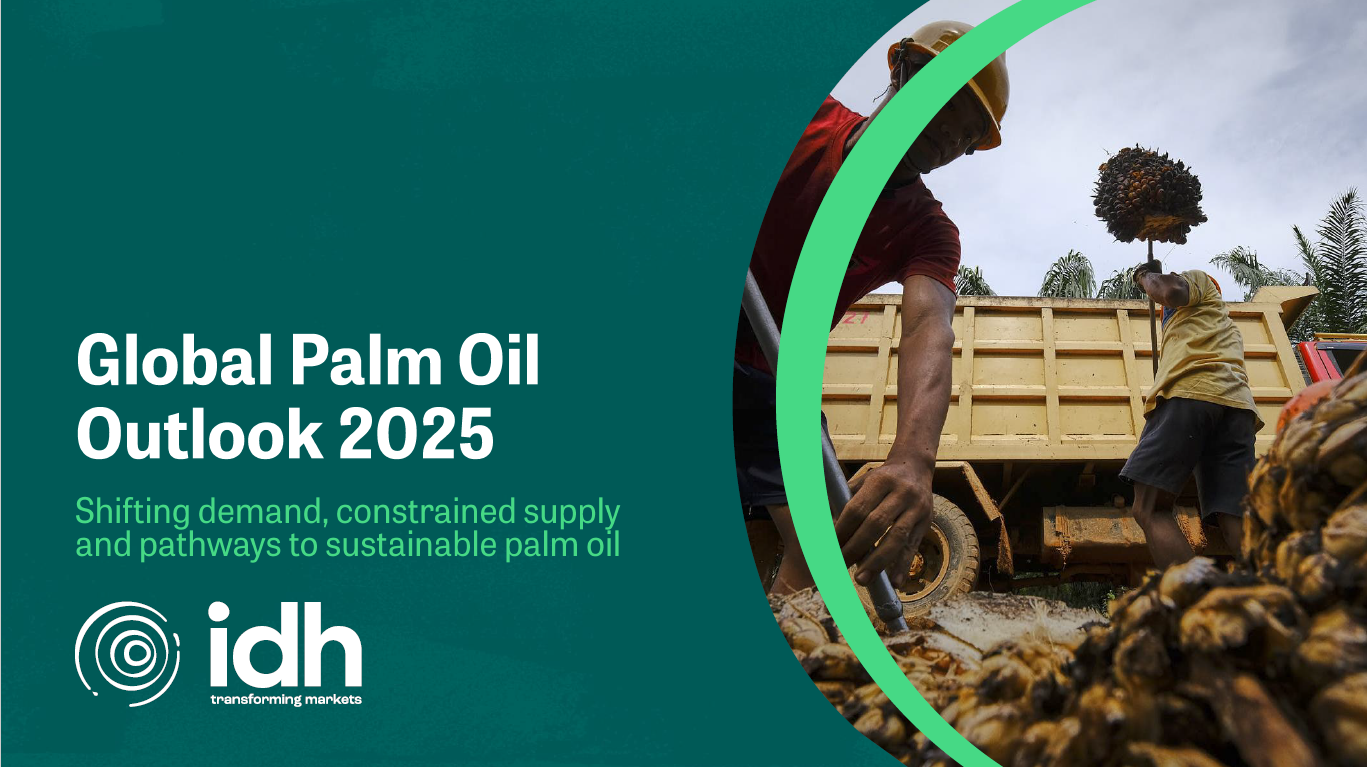
Global Palm Oil Outlook 2025
This resource was originally published by IDH.
June 9, 2026
This report provides an evidence-based analysis of how the global palm oil sector is being reshaped by shifting demand, tightening supply, and persistent coordination failures. Its central finding is that the sustainability frameworks built over the past two decades were designed for market conditions that are rapidly changing: EU and China consumption has declined significantly, while growth is concentrated in producer markets and industrial uses where sustainability plays a far weaker role in purchasing decisions. At the same time, independent smallholders — who produce 35–40% of global palm oil — remain largely excluded from certified and traceable supply chains, with only 8% of RSPO-certified supply coming from smallholder producers.
The report makes a direct and well-documented case for landscape and jurisdictional approaches (LJAs) as the most credible mechanism currently available to address barriers that individual supply-chain actors cannot solve on their own: land registration, legality systems, plot-level traceability, and smallholder finance. Drawing on CDP 2025 disclosure data and two detailed case studies from Aceh, Indonesia and Sabah, Malaysia, it illustrates both the potential and the limitations of LJAs in practice — noting that while participation has grown rapidly (from 27 to 388 companies between 2022 and 2025), 90% of initiatives remain below full implementation maturity. The report closes with concrete recommendations for each type of actor in the system, from end-market buyers to producing-country governments, making it a practical resource for practitioners, conveners, and buyers engaged in or considering landscape-level investment.
Global Palm Oil Outlook 2025