
This story is related to the landscape initiative “The Mosaik Initiative”, and originally published on SourceUp.
Sudjarwo, a Bridge of Hope for Patchouli Farmers in Rungau Raya
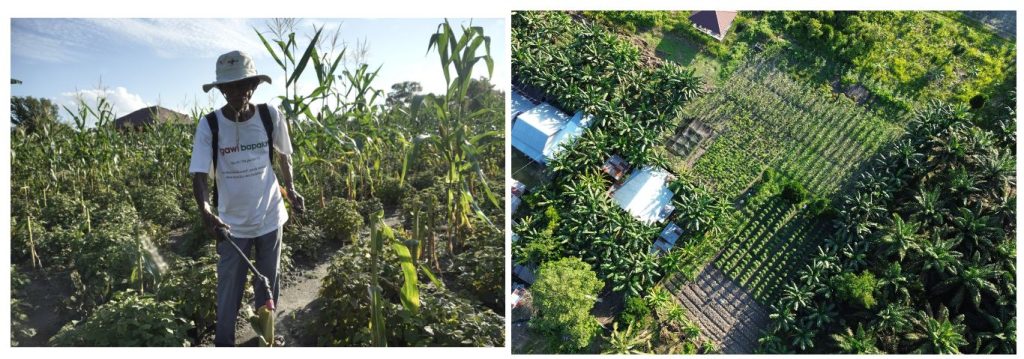
At an age when most people choose to slow down, Sudjarwo—affectionately known as Mbah Jarwo—can still be seen walking along narrow footpaths toward his fields, carrying a spirit as youthful as his stride. Moving from one plot to another, he observes his patchouli plants and repeats the conviction he has held for years: that patchouli is not merely about planting and harvesting, but about safeguarding the dignity of farmers. To him, patchouli is more than a high-value essential oil crop; it is a symbol of resilience and solidarity.
In Kalimantan, oil palm has long dominated the landscape of plantations. Nearly all farmers have tied their livelihoods to this commodity because it is considered the safest choice—its market is stable and has supported rural communities for decades. Yet behind this dominance lies another crop whose value quietly rivals it: patchouli (Pogostemon cablin Benth), the plant that produces the highly sought-after patchouli oil.
For Mbah Jarwo, patchouli is not a new story. More than two decades ago, he experienced firsthand the risks of cultivating it without market certainty. That experience once made him hesitant to return to patchouli farming. But when a new opportunity emerged—with a clearer and more reliable scheme—he chose to step forward, leaving the past behind.
Mbah Jarwo’s long journey began long before patchouli reappeared in his village of Rungau Raya, Danau Seluluk Subdistrict, Central Kalimantan. A graduate of the Hollandsch Inlandsche Kweekschool (HIK), a teacher training school from the Dutch colonial era, and a former student of a puppetry school in Surakarta, he once pursued a path as both an artist and a teacher. Fate, however, brought him to Kalimantan in 2001, where he worked in the contracting sector before eventually turning to farming. “I used to plant rubber, but when it wasn’t selling, I cut it all down. Then I became a vegetable farmer,” he recalled.
In 2004, he incurred losses while cultivating patchouli. At the time, the price of patchouli oil fluctuated drastically, dependent entirely on international markets. So when a new program introduced patchouli cultivation in his village in 2023, Mbah Jarwo initially refused. “I had once been a victim of patchouli,” he admitted frankly.
However, the explanation from the program team eventually changed his mind. When he saw that a distillation facility had been established in Rungau Raya Village, along with a patchouli nursery, his eyes lit up—he sensed a new opportunity. As an elder in the village, he took the initiative to encourage landowners to try planting patchouli together. “If no one is willing to try, nothing will ever move forward,” he said.
The decision, however, was far from easy. The first batch of 450 seedlings he received in polybags died almost entirely. “They grew well at first, but eventually wilted and died,” he explained. The next batch arrived in larger quantities, but packaging issues during transport meant they were not in optimal condition for planting. Even so, Mbah Jarwo did not give up. He replanted, improved his cultivation methods, and learned to propagate patchouli cuttings on his own to multiply the seedlings. In time, test distillations showed that patchouli oil from Seruyan had remarkably high quality. “It turns out Kalimantan soil is suitable for patchouli,” he said with optimism.
He emphasized the importance of patience. Mbah Jarwo knows all too well that patchouli farming is not an instant endeavor with immediate returns. He urges that seedlings must be managed properly and farmers must receive continuous guidance. Patchouli can only be harvested for the first time six months after planting, and then every three months for up to three years before the plants need to be rejuvenated. While waiting, he recommends planting corn between the patchouli rows. “Corn can be harvested quickly, the yield is good, and farmers can still earn income while waiting for the patchouli,” he explained.
He also stressed that what farmers need is not merely incentive assistance, but real, tangible support: quality seedlings, adequate fertilizer, and clear market access. He even proposed maintaining cattle to ensure a steady supply of manure. For Mbah Jarwo, all of these are essential requirements before talking about profits. “If the price is around Rp3,500–5,000 per kilogram of young leaves, farmers can already benefit,” he said, with one clear condition: that the cultivation and distillation processes are properly supported.
But for Mbah Jarwo, profit and loss are not everything. He understands that companies can also suffer losses when seedlings and production fail to meet required standards. For that reason, he has never demanded compensation. “I’m a small entrepreneur myself. If the company loses money, I feel it too. What matters is how this effort can continue and how the community can be involved,” he said.
Today, Mbah Jarwo has formed a farmer group called Nilam Sari Jaya, although he refuses to serve as its leader. “I don’t want that—people might think I’m acting as a broker. I only want to advise and encourage the community to take part,” he said humbly.
Despite his age, Mbah Jarwo’s spirit remains unwavering. He willingly goes back and forth, meeting farmers, offering motivation, and is even ready to act as a bridge between the community and the company. “I mean it—I’m ready to help. If this initiative is transparent and mutually beneficial, then we can move forward together,” he said with conviction.
Behind his simple words lies a profound determination: to ensure farmers are not underestimated, to make patchouli a viable source of livelihood, and to keep the spirit of gawi bapakat (working together) alive in Seruyan.