
This story is related to the landscape initiative “The Mosaik Initiative”, and originally published on SourceUp.
Reni: A Homemaker Way to Provide Nutrients by Agriculture Sustainably
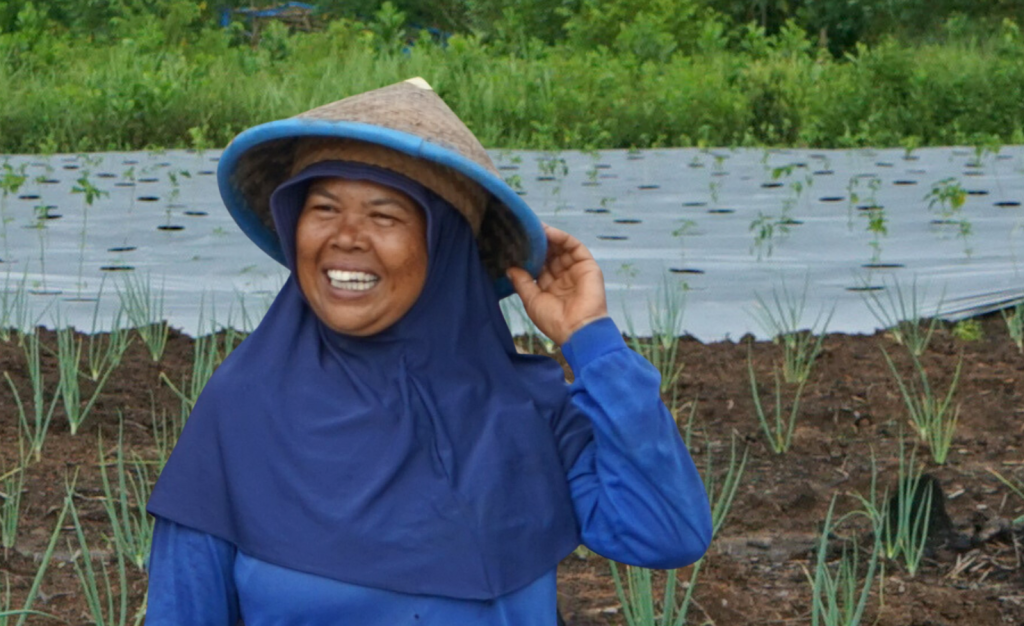
Reni, a female farmer in Bangkal village, is determined to grow food with regenerative agriculture to feed her family healthy food while being considerate of the health of the soil.
As a wife and a mother, the 52-year-old woman has to make sure that her family consumes a decent amount of healthy food daily while contributing to the household’s income. So, when she first moved and decided to settle in Bangkal, she and her husband used the land beside her house to grow food crops by practicing regenerative agriculture. Then, they start working hand in hand to tend to their land. They are even trusted to take care of other people’s land and implement regenerative agriculture. They are currently tending for one-hectare of land next to their house and the land of a close acquaintance entrusted to them.
Reni and her husband, Sukiyo, have planted several food crops there, such as eggplant, long beans, peanuts, corn, chili, cassava, and watermelon in intercropping style. After the harvest season, the couple uproots the crop residues and let the soil recover for 2-3 months to bring back the nutrients of the soil. As for fertilizers, they utilize the crop residues they uprooted earlier with effective microorganisms-4 (EM4) solution to cover the land and prepare them for the next planting. They have not produced other types of organic fertilizer, such as manure, because they do not have cattle stock yet, even though the couple has received training to produce them independently.
She also followed a tight schedule for navigating her daily chores as she had to play different roles, such as a wife, a mother, or a farmer. She woke up early, at 4 o’clock, to clean the house first thing in the morning. Her routine continued until 4 p.m., when she visited the crops and checked their conditions.
Without prior experience in agriculture, she meticulously learned by doing, as she directly practiced what her husband taught her about how to hoe the land, plant the seeds, apply manure, and other farming techniques. But since her husband also has another job in a palm oil plantation company as a harvest laborer to make ends meet, she is become the primary handler of their land, which makes her thoroughly understand its condition.
“So far, applying organic fertilizers has given us many benefits. As an example, our crops become more resilient to external threats. The soil in our land also becomes increasingly healthy with its loose texture and dark color. It has a good effect on our crops.” She proudly showed the growing plants on her land, which she has tended to for a year.
Then, she continued sharing her worries regarding fertilizers: “Unfortunately, the quality of organic fertilizer (from the factory) that we’re currently using along with the crop residue is not that good, so I wish we could afford organic fertilizer with better quality, or better yet, we could produce our manure fertilizers in the future.”
By practicing regenerative agriculture, she ensures her family always gets fresh food straight from their land. She also sells crops for daily needs and farming materials such as fertilizers and EM4 solutions. Her farming practice and the benefits she feels have motivated a few other villagers to start learning and implementing regenerative agriculture.
“Going forward, I hope what we currently do can motivate other villagers in Bangkal to not only start maintaining their food supply by farming independently but also by practicing sustainable agricultural practices, just like regenerative agriculture,” Reni said while showing a bright smile as she conveyed her hope for the prosperity and sustainability of Bangkal’s agriculture.
With her many roles, Reni shows that there is always room for learning new things to improve life. In doing so, she not only sustains her family by providing nutritious food but also inspires fellow farmers to protect the ecosystem by practicing regenerative agriculture.